Running a supermarket
Every till open at once, and not one of them disagrees with another
Hadoo builds the system a supermarket in Czechia runs on: every lane selling from the same price list, each one keeping its own shift and its own drawer, promotions that apply themselves, and the stock figure moving as the queue moves.
What the till sells leaves the shelf, what the back door takes in lands on the stock figure, and both reach your accountant without anyone typing them twice.
- A free morning in your shop, during a shift, from the back door to the queue.
- Initial setup is free: data migration, warehouses, price lists, training.
- Advice and support in Vietnamese, straight from the people who built the system.
Common trouble
The counter is where every loose end shows up
Everything the shop gets wrong somewhere else arrives at the till with a customer attached to it. You may recognise a few of these.
The queue waits while somebody checks a price
The shelf label says one thing, the till says another, and the person at the counter has to decide in front of five customers. Whoever decides, somebody loses money.
What the till sold never reaches the stock figure
The shop sells all day and the warehouse finds out at the next count. Ordering is guesswork, the web shop offers goods that went out this morning, and nobody trusts the number on the screen.
A customer asks for an invoice and the shift stops
A business customer wants a proper invoice with their IČO on it. Somebody writes the details on paper, and the accountant rebuilds the transaction a week later from a receipt.
The drawer and the takings disagree at closing
Cash, cards, bank transfers and the odd refund end the day in different places. Counting up takes half an hour, and a difference has no name against it.
Promotions live in somebody's head
The campaign started on Monday and whoever is on the till today was not told. It ended last week and is still being given away. Afterwards nobody can say what it cost.
Fresh goods reach their date on the shelf
Nobody is watching the dates on two thousand lines, so what has gone over is found by a customer, or at the next count. What it cost this month is a figure the shop never sees.
A price changed at the office reaches one till and not the next
Two lanes charge two different prices for the same item on the same afternoon. Whichever one the customer went through, somebody is going to hear about it.
A second till opens and nobody can say what it took
The extra lane is opened for the Saturday rush on whatever was free. At closing its takings are in the same drawer as everything else, and the day cannot be split back apart.
Not every supermarket should start by replacing the tills
Sometimes the tills are fine and the trouble is at the back door: goods arriving without codes, prices kept in a spreadsheet, nobody owning the stock figure. Hadoo spends a morning in the shop first and says which it is, even when the answer is that you do not need new tills this year.
What Hadoo does
One system, from the back door to the till
The till is not a separate program that reports in at night. The counter, the stockroom, the price list and the books read the same products and write back to each other as the day goes on.
Till · At the counter
Scan, take the money, next customer
Staff scan the barcode, the till takes the price from the list that applies, puts the right promotion on it and records the payment. A new member of staff can be taught it in a morning, because there is nothing to remember.
- Scanned, weighed or picked off the screen, whichever the goods need
- Screens in Vietnamese, Czech or English, chosen per person
- Goods sold by the piece, the pack or the case, at the price each carries
Several tills at once
Open another lane and it already knows everything
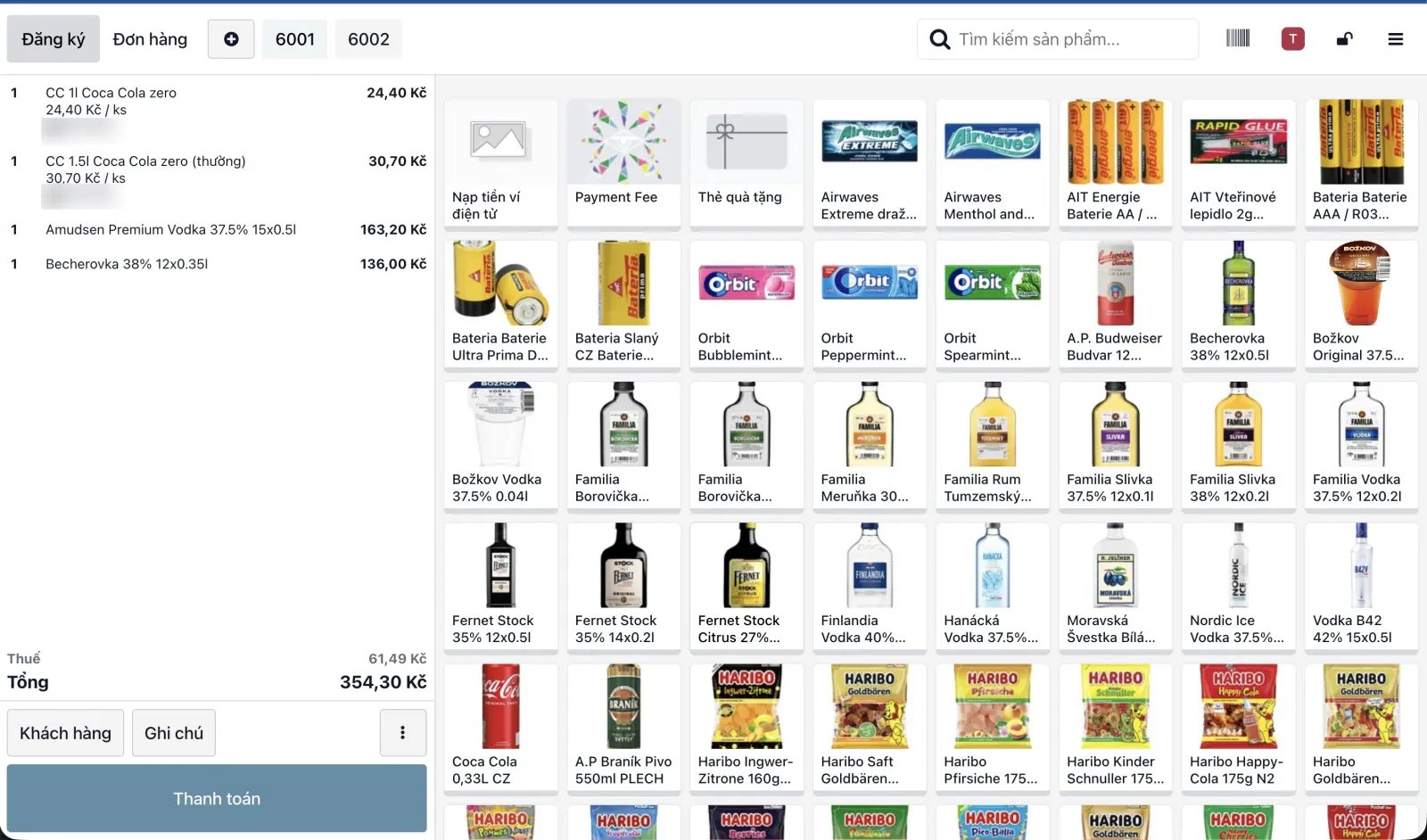
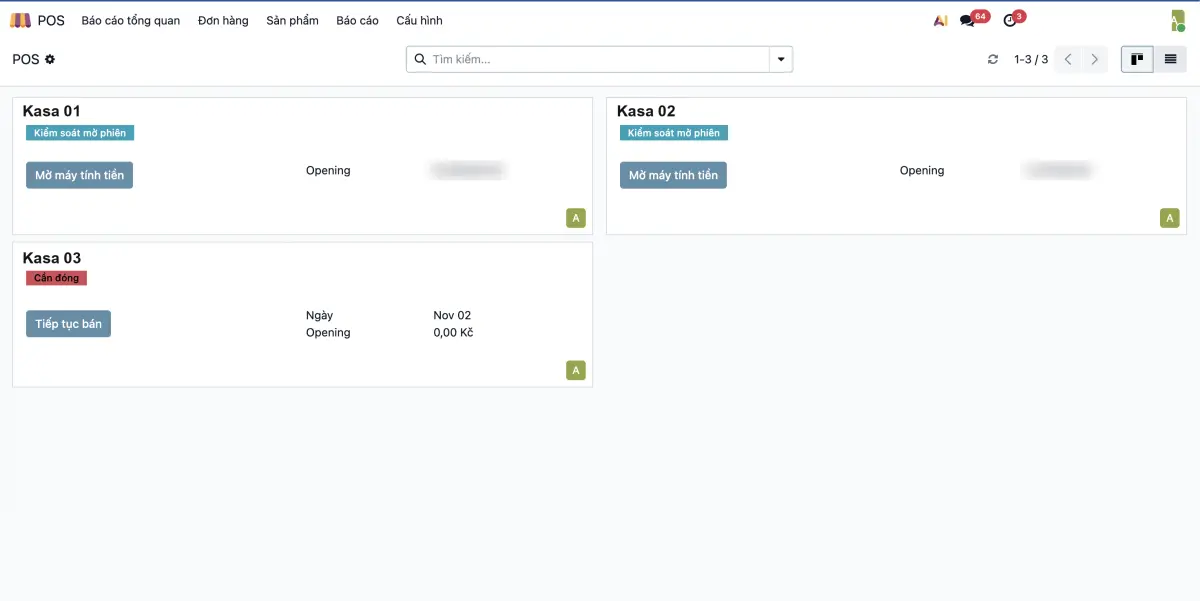
A supermarket does not run one till, it runs as many as the hour needs. Every one of them sells from the same products, the same price list and the same promotions, while keeping its own drawer and its own takings. Opening one more for a Saturday is a few minutes, not a project.
- Every till reads the same products, prices and promotions, so two lanes cannot charge differently
- A price changed once is the price on every till, without anybody walking round them
- Each till keeps its own drawer, its own shift and its own takings
- A sale rung up at one till is refunded or corrected at any other
- Several shops and several companies on the same system, each with its own figures
- A till added for a busy weekend is set up in minutes and behaves like the rest
Shifts and staff
Who was on which till, and what they changed
Lanes change hands during the day. Everyone signs in under their own name, so the shift that is open, the drawer that gets counted and the correction somebody made at half past four all have a person against them rather than a shrug.
- Staff sign in on any till with their own name, and sign out when they leave it
- Each shift opens and closes with a count of its own, so a difference belongs to a shift
- Voids, refunds and price overrides carry the name of whoever made them
- A lane handed over mid-shift does not have to be cashed up first
Payments
Cash, card and a bank transfer the customer scans
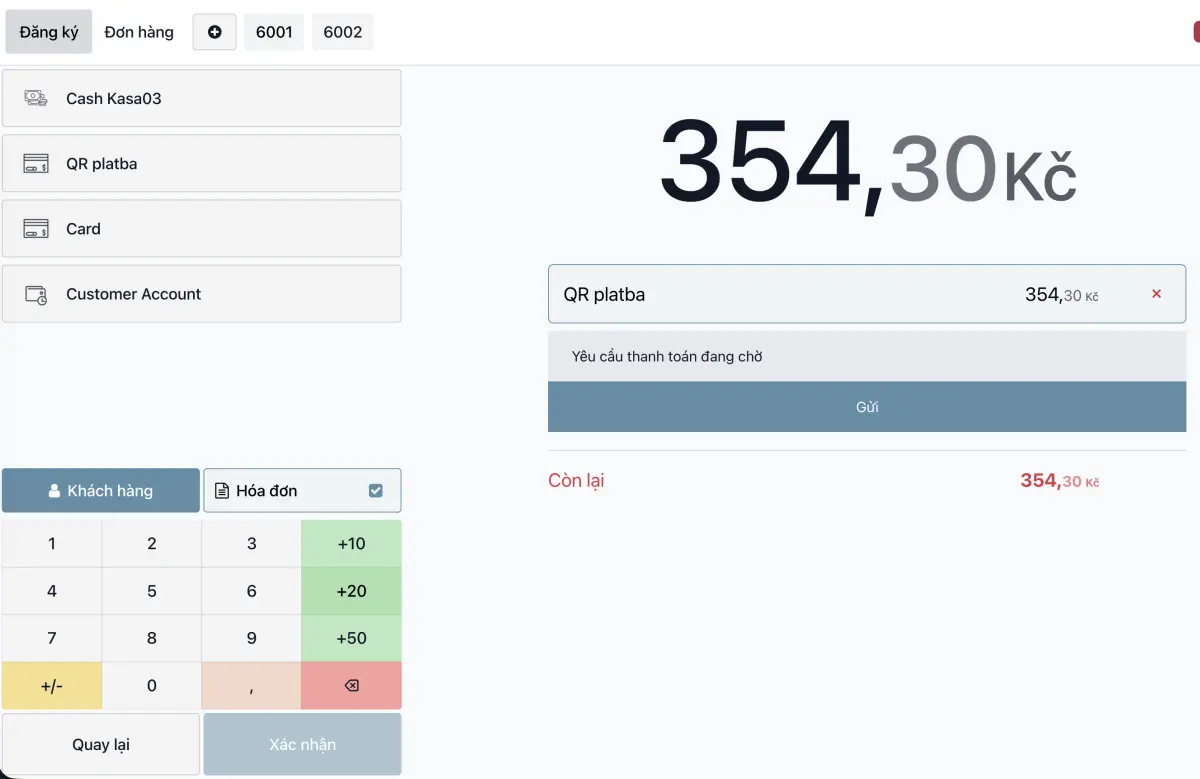
One sale can be settled more than one way, and the till keeps them apart: what went in the drawer, what went through the terminal, what arrived in the account. A QR code on the screen lets a customer pay by transfer without a terminal fee.
- Cash, card and QR bank transfer on the same screen
- One sale split across two ways of paying, recorded as two
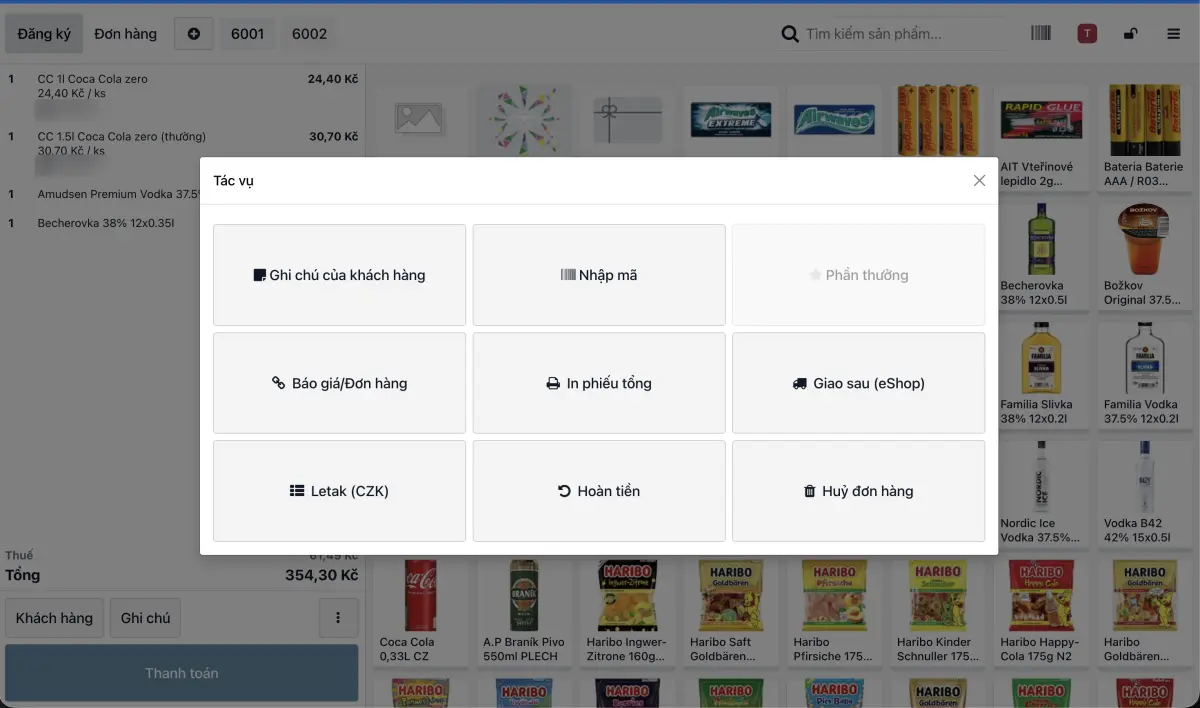
- A bill printed for the customer before they pay, so there is no argument at the counter
- Refunds and corrections tied to the sale they came from
Receipts and invoices
A business customer gets a real invoice, at the counter
When the customer asks for an invoice, the till asks for the IČO and fills the rest from the public register. The invoice carries the Czech requirements, and the shift does not stop while somebody writes an address down.
- Type the IČO and the name, the address and the DIČ come from ARES
- Several counter sales for one customer put on a single invoice
- An invoice printed again later, from the document that was issued
- Corrective invoices for returns, in the form the law asks for
Prices and promotions
A campaign starts because a date arrived, not because someone remembered
Prices and campaigns are set once, in one place, and the till applies them. A promotion switches itself on and off by date, and afterwards the figures say what it actually brought in.
- Retail, wholesale and dealer price lists
- Promotions, vouchers and buy-one-get-one, switched on and off by date
- Shelf labels printed from the same price the till is going to charge
- A price list drafted first and loaded into selling only once it is approved
- Shelf labels printed from the same prices the till charges
Stock behind the counter
What leaves the shelf leaves the figure
A sale at the till moves the stock the moment it happens, so the shop, the warehouse and the web shop are reading one number. Goods can be picked and set aside for a customer before they arrive to collect them.
- Stock moved by the sale, not by a job that runs at night
- Goods picked with a scanner for a counter customer or a web order
- Batch and expiry dates carried through to what is sold
- Stock held for the shop kept apart from stock held for the e-shop
Customers
The regular at the counter is the customer in the system
A customer who buys at the counter and a customer who orders online are one record: what they bought, what they still owe, which invoices went out. The notebook under the till stops being the only copy.
- Receivables covering counter sales and web orders together
- What a customer owes visible at the till, before the next sale
- Separate price lists for wholesale customers, dealers and regulars
- Purchase history a member of staff can look up within their rights
Goods in · At the back door
The delivery is checked against the order, not against memory
What arrives before opening has to be on the shelf and on the stock figure by the time the first lane opens. The goods are scanned against the order at the back door, and what the supplier charged is read off their own document instead of being typed in again.
- Receiving scanned against the order, on a phone, by whoever is unloading
- Supplier invoices and delivery notes read into a draft receipt, with the purchase price on every line
- The cost that arrives with the goods reaches the selling price the same day
Dates and counting
What is close to its date, and what the shelf actually holds
Fresh goods and the count are the two places a supermarket loses money without noticing. Each batch carries its own date, the shelves are walked with a phone, and counting is done an aisle at a time during the day instead of by closing the shop.
- Goods tracked by batch, with the date on the batch rather than in somebody’s head
- A shelf walk on a phone: scan, write the date, move on
- What is nearest its date listed first, so it is sold, marked down or pulled in time
- A line nobody has dated is listed as undated, never treated as fresh
- Counting with a phone, aisle by aisle, without closing the shop
- Goods written off carry a reason, so breakage, theft and dates are told apart afterwards
Cashing up
The end of the shift takes minutes and leaves a record
At closing the drawer is counted against what the till says it took, by payment method. A difference is written down with the shift and the person it belongs to, instead of being argued about the next morning.
- Takings by shift, by till and by way of paying
- Counted cash against expected cash, with the difference recorded
- Money moved out of the drawer during a shift written down as it happens
- Yesterday's shift still openable to correct a sale that was mis-rung
Accounting
The accountant gets a file, not a shoebox
Takings, invoices, refunds and the way each sale was paid for carry through to the books in the shape a Czech accountant works in. Nobody retypes a day of receipts at the end of the month.
- Invoices and corrective invoices to Czech requirements, VAT at 21 % and 12 %
- Exported for POHODA as XML or as Excel, whichever your accountant works with
- The day's takings without an invoice carried across as their own entry
- Bottle and packaging deposits set up for the way you sell
On screen
What it looks like in daily use
Screens from a shop selling in Czechia: the tills and their shifts, paying by QR transfer, and what the counter can do with an order besides take the money for it.
The parts
Nothing says you have to start with all of it
One shop needs the till and nothing else for now. Another has the till and cannot see its stock. A third wants the counter and the web shop selling from one set of goods. Start where it hurts.
POS
At the counter
Sales, payments, promotions, shifts and the takings of each till.
Inventory
Stock
What is on the shelf, what is in the back, batches and expiry dates.
Barcode
On the floor
Receiving, picking, counting and expiry dates, all from a phone.
Purchase
Ordering
Orders to suppliers, the prices they quote, and what each delivery actually brought.
Sales
Selling
Quotations, orders, price lists and terms for wholesale customers.
E-shop
Selling online
A web shop reading the same goods, prices and stock as the counter.
CRM
Customers
One customer file, their purchases and what they still owe.
Accounting
The books
Invoices, VAT, receivables, payments and the exchange with POHODA.
Reporting
Reports
Takings by shift and by shop, what sells, and the margin on it.
Doing business in Czechia
Not only workable, but within the local rules
A counter in Czechia answers for what it charges, what it prints and what it hands to the accountant. That is the part Hadoo pays the most attention to.
Invoices and VAT
The VAT rates in force, 21 % and 12 %, sales documents and corrective invoices to the requirements of the law. Local practices such as bottle deposits are set up to match the way you sell.
Goods the law treats differently
Alcohol and tobacco, the age check at the counter and bottle deposits are set up the way the shop actually sells them, instead of being left for whoever is on the till to remember.
The POHODA link
Sales, invoices and documents exported in a structure accounting can import into POHODA, as XML or as Excel, whichever your accountant already works with.
Getting ready for EET 2.0
Electronic sales records return under a timetable that starts in 2027. Hadoo follows the official rules and goes through the assessment, the preparation and the changes with you when it takes effect.
How this works
Stand at the counter first, propose software after
A supermarket is busy at particular hours and quiet at others, and the trouble shows at the busy ones. So Hadoo comes during a shift, not during a meeting.
Step 1
Talk it through
Hadoo gets in touch to understand the shop, how many tills there are, how the goods come in, what runs it today and what is getting in the way.
Step 2
A morning in the shop
Watching every lane open at the busy hour, a shift changing hands, a real invoice request and a real closing, with the people who do each one. This one is free.
Step 3
A proposal and a price
You get the scope, the features, the cost and the timeline in writing, and decide after reading it.
Step 4
Setup, data and the hardware
Moving products, prices, customers and receivables across, wiring up the printer, the scanner and the card terminal, and training the shift on the till.
Step 5
Alongside you afterwards
Technical support, answers, and room to grow when you add a till, a shop or a new process.
What happens at your counter that should not?
Maybe the queue waits, maybe the stock figure is a guess, maybe invoices eat the shift. Write a few lines about the shop and Hadoo comes back within one working day.
The first consultation and the hour at your counter cost nothing, and you are under no obligation to buy afterwards.
What happens next
Within one working day
Hadoo rings to ask a few questions about the shop and what is most urgent.
An hour at the counter
During a shift, watching the queue and the closing as they really go. No charge.
A proposal with a price
Written down: what gets done, by when and for how much. You read it, then decide.
Your old data
Products, prices, stock, customers and receivables move across before the old till is switched off.
Other models
Does your business run its own way?
Questions
What shop owners ask most
Where should we start?
By whichever thing is costing you most. If the shelf price and the till price disagree, start with price lists and the till. If the stock figure cannot be trusted, start with receiving and barcodes, because a till reading a wrong figure is still wrong. If invoices eat the shift, start with the counter and ARES. Hadoo says which it is after the hour at your counter, and the scope is written down before anything is bought.
How many tills can run at the same time?
As many as the floor needs. What limits it is the hardware you put out, not a charge per till, so an extra lane for a Saturday or for December is worth opening. Each one runs its own shift and its own drawer while reading the same prices as the rest, which is why adding one does not mean setting anything up a second time.
Two thousand lines, and a lot of them have dates. Where do the dates come from?
From whoever puts the goods away. The batch is scanned and its date typed in once, at the back door or on a shelf walk, and from then on the shop can be asked what is close to running out of time. Nothing guesses a date: a line nobody has dated is listed as undated rather than counted as fresh, which is the only way the list stays worth reading.
Can the till still sell when the internet is down?
That depends on how it is set up. The till can carry on selling while the connection is down and sync once it is back, but anything that needs fresh data, such as stock in another shop, has to wait. Hadoo goes through what works offline, and its limits, during the consultation.
Do we have to buy new hardware?
Usually not all of it. A receipt printer, a scanner and a cash drawer that already work often keep working, and the till itself runs in a browser on a computer or a tablet. Hadoo checks what you have during the walkthrough and says what has to be replaced before you buy anything.
We run more than one shop, and more than one company.
That is normal here and it is set up on purpose: each company holds its own stock, its own invoices and its own takings, while the counters work the way they always did. Movements between them are recorded as they happen rather than reconstructed at the end of the month.
A customer wants one invoice for several visits. Can we do that?
Yes. Counter sales for the same customer can be put on one invoice instead of one document per visit, which is what a business customer buying a few times a week usually wants. The receipts stay as they were; the invoice is raised on top of them.
My staff do not speak Czech. Can they use it?
Yes. The screens come in Vietnamese, Czech and English, and each person picks their own. Documents for customers are set up to the requirements that apply. Training and support are in Vietnamese.
Somebody rang a sale up wrong yesterday. Can it be fixed?
Yes, and it leaves a trail. A sale can be corrected into the shift it belongs to rather than today's, so the takings of each day stay right. Who changed what, and when, is recorded, which is the point of doing it in the system instead of in the drawer.
Does Hadoo connect to POHODA?
Yes. Hadoo works out how data should pass between your system and POHODA. Depending on what you need, it goes out as XML or in an Excel structure your accountant can take in and process.
How long before we can sell on it?
It depends on the number of tills, the state of the old data and what you need built. After the walkthrough Hadoo sets out the route and the milestones so you can plan around them, rather than promising a date before seeing the till you run today.
Start with whatever holds up the queue
Nothing has to change in a single day. You keep selling; Hadoo gets the counter and everything behind it reading the same figures.